EAR & ITAR NOTICE:
Products purchased from this website may contain hardware/technical data within the definition of 15 CFR Chapter VII, Subchapter C – EXPORT ADMINISTRATION REGULATIONS Part 730 through 774, as well as 22 CFR Chapter I, Subchapter M – INTERNATIONAL TRAFFIC IN ARMS REGULATIONS part 120 through 130,and may be subject to the export control laws of the U.S.
The unauthorized reproduction, dissemination, or transfer of these products or technical data by any method to a foreign person, whether within the U.S. or abroad without the written authorization of the Department of Commerce Bureau of Industry & Security (BIS), Department of State Directorate of Defense Trade Controls (DDTC), or Department of Treasury Office of Foreign Assets Controls (OFAC) is strictly prohibited by law. (Please see 15 C.F.R., 22 C.F.R., 18 U.S.C., 22 U.S.C., and 50 U.S.C. for additional information)
Due to these laws and regulations, HighCom Armor is required to only sell our products to lawful U.S. persons unless with an approved export license and therefore we use a simple method to verify proof of citizenship/residency before processing and delivering purchased protective products. By placing an order on our website you agree to these requirements and that a request for your passport, birth certificate, and/or other form of identification may be required. If you refuse to provide this information your order will be canceled and a full refund will be provided.
Q. Why does HighCom Armor require proof of U.S. person status and others don’t?
A. This is a HighCom Armor company policy and we are unable to speak on behalf of other companies. However, export compliance is extremely important to HighCom and because of U.S. laws restricting the sale/transfer of controlled items (Body Armor) to foreign persons, HighCom has found the most effective, quickest, and easiest method while also keeping administration costs low in order to pass along savings to our customers is in the form of requiring a birth certificate or passport as proof of citizenship/residency.
Some individuals may question this as us refusing to sell to law abiding citizens and this could not be further from the truth. In fact, the entire point of this policy is to ensure we are only selling to legal law abiding U.S. persons. Please know that although other companies may accept a driver’s license as proof of citizenship/residency this is not an effective way for HighCom to prove citizenship/residency as many States within the U.S. are now allowing foreign persons and even illegal aliens to obtain drivers licenses and other federal and state identification and benefits.
HighCom Armor is a manufacturer and exporter of defense articles who maintains sales to legal U.S. person as well as federal, state, and local law enforcement and DOD contracts in addition to support of foreign military and coalition forces globally. The risk posed with a foreign person obtaining this equipment whether internationally or domestically without the proper approval is too great for HighCom to take without this simple policy. We understand there are alternative choices in the market and are not forcing this policy on anyone who chooses to buy elsewhere. Please know your business is extremely important to us and so is the National Security of the United States. Please know these are real laws and regulations and not something we have made up to complicate our business practices.
To learn more about these regulations and laws please visit the agency websites below;
The word export, as used in the ITAR, includes the obvious activities of sending or taking any ITAR-controlled commodity or information out of the United States. However, the term export also includes transferring EAR and ITAR-controlled commodities or information within the United States to anyone not a U.S. citizen or lawful permanent resident (with certain narrow exceptions). Given this definition, transfers of ITAR controlled commodities or information to non-U.S. employees of U.S. companies entirely within the U.S. are exports.
If the individual is not a U.S person, when applying the “deemed export” rules the EAR looks at the person’s most recent citizenship or permanent residence whereas the ITAR looks at the person’s country of origin (i.e., country of birth) and all current citizenship’s.
The most important phrase, from which most other ITAR definitions flow, is the phrase “defense article.” The ITAR defines “defense article” as any item or “technical data” identified on the USML, which is set forth in Part 121.1 of the ITAR. The definition of defense article additionally includes models, mockups, and other physical forms that reveal technical data directly relating to USML items.
BODY ARMOR classified on ITAR as category X personal protective equipment including NIJ level IV or higher performance body armor plates.
BODY ARMOR classified on EAR as category 1A005 and 1A613 as body armor, including NIJ level Type IIA, II, IIIA, or III.
§ 120.62 U.S. person.
U.S. person means a person who is a lawful permanent resident as defined by
8 U.S.C. 1101(a)(20) or who is a protected individual as defined by
8 U.S.C. 1324b(a)(3). It also means any corporation, business association, partnership, society, trust, or any other entity, organization, or group that is incorporated to do business in the United States. It also includes any governmental (federal, state, or local) entity. It does not include any foreign person as defined in § 120.63 of this part.
If you have additional questions on this matter please feel free to contact HighCom or feel free to contact the U.S. government agencies directly at any of the below phone or email addresses to inquire about the specific laws or regulations cited above.
ITAR DDTC
U.S. Department of State DDTC- Phone: (202) 663-1282
E-mail: ddtccustomerservice@state.gov
EAR BIS
To speak with an export counselor, you may call one of the following numbers:
(202) 482-4811 – Outreach and Educational Services Division (located in Washington, DC)
(949) 660–0144 – Western Regional Office (located in Irvine, CA)
(408) 998-8806 – Northern California branch (located in San Jose, CA)
or e-mail your inquiry to the Export Counseling Division of the Office of Exporter Services at: ECDOEXS@bis.doc.gov
OFAC DOT
Toll Free Hotline 1-800-540-6322
Local Hotline 1-202-622-2490
OFAC Licensing Division (Direct) 1-202-622-2480
BACKGROUND SCREENING
HighCom Armor performs background screening for all of its customers and suppliers against the following lists;
- Department of Commerce Denied Persons [BIS]
- Department of Commerce Entity List [BIS]
- Department of Commerce “Unverified” List [BIS]
- Department of State Arms Export Control Act Debarred Parties [DDTC]
- Department of State Munitions Export Control Orders [DDTC]
- Department of State Nonproliferation Orders
- WMD Trade Control Designations [OFAC]
- Department of State Designated Terrorist Organizations
- Department of State Terrorist Exclusion List
- Palestinian Legislative Council List [OFAC]
- Federal Register General Orders
- Specially Designated Nationals and Blocked Persons [OFAC]
- Foreign Sanctions Evaders List (FSE-IR) [OFAC]
- Sectoral Sanctions Identifications List (UKRAINE-EO13662) [OFAC]
- United Nations Consolidated List
- GSA Parties Excluded from Federal Procurement Programs [SAM/EPLS]
- GSA Parties Excluded from Federal Nonprocurement Programs [SAM/EPLS]
- GSA Parties Excluded from Federal Reciprocal Programs [SAM/EPLS]
- Air Force Special Investigations – Top Ten Fugitives
- Alcohol, Tobacco, Firearms and Explosives Most Wanted
- FBI Ten Most Wanted Fugitives
- FBI Most Wanted Terrorists
- FBI Seeking Information
- FBI Wanted Fugitives
- Food and Drug Administration – Clinical Investigators
- Food and Drug Administration – Debarment List
- Food and Drug Administration – Disqualified and Restricted
- Homeland Security Investigations Most Wanted
- Naval Criminal Investigative Service – Wanted Fugitives
- U.S. Immigration and Customs Enforcement Most Wanted
- U.S. Drug Enforcement – Major International Fugitives
- U.S. Marshals Service – Major Fugitive Cases
- U.S. Marshals Service – Top 15 Most Wanted
- Office of Research Integrity PHS Administrative Actions
- U.S. Postal Inspection Service – Most Wanted
- U.S. Secret Service Most Wanted
- Japan Foreign End-Users of Concern
- Kingdom of Saudi Arabia Wanted Militants
- CPSEP Listed Entities
- Australia Foreign Affairs Consolidated List
- European Union Consolidated List
- Interpol Recently Wanted
- HM Treasury Consolidated List [England]
- Canadian Economic Sanctions
- Canadian Border Services Agency Wanted List
- RCMP Wanted Fugitives
- FinCEN (USA PATRIOT Act) Section 311 – Special Measures
- World Bank Listing of Ineligible Firms
- OSFI Consolidated List – Entities
- OSFI Consolidated List – Individuals
- OSFI Warning List
OVERVIEW
This website is operated by HighCom Armor Solutions, Inc. Throughout the site, the terms “we”, “us” and “our” refer to HighCom Armor. HighCom Armor offers this website, including all information, tools and services available from this site to you, the user, conditioned upon your acceptance of all terms, conditions, policies and notices stated here.
By visiting our site and/ or purchasing something from us, you engage in our “Service” and agree to be bound by the following terms and conditions (“Terms of Service”, “Terms”), including those additional terms and conditions and policies referenced herein and/or available by hyperlink. These Terms of Service apply to all users of the site, including without limitation users who are browsers, vendors, customers, merchants, and/ or contributors of content.
Please read these Terms of Service carefully before accessing or using our website. By accessing or using any part of the site, you agree to be bound by these Terms of Service. If you do not agree to all the terms and conditions of this agreement, then you may not access the website or use any services. If these Terms of Service are considered an offer, acceptance is expressly limited to these Terms of Service.
Any new features or tools which are added to the current store shall also be subject to the Terms of Service. You can review the most current version of the Terms of Service at any time on this page. We reserve the right to update, change or replace any part of these Terms of Service by posting updates and/or changes to our website. It is your responsibility to check this page periodically for changes. Your continued use of or access to the website following the posting of any changes constitutes acceptance of those changes.
Our store is hosted on Shopify Inc. They provide us with the online e-commerce platform that allows us to sell our products and services to you.
SECTION 1 – ONLINE STORE TERMS
Thank you for visiting www.HighComonline.com, the online marketplace for HighCom Armor products sold directly from the manufacturer. Please review the following Terms and Conditions. If you visit or purchase products on the HighCom Armor website, you accept these terms. We reserve the right to make changes to our site and to these terms and conditions at any time without notice. Your use of the site following any such changes shall confirm your agreement to follow and be bound by the terms as modified.
With any purchase from HighCom Armor you are confirming and stating that you are a legal adult (18 years or older) and are not a felon or have a Criminal Record. We do not promote nor condone the selling of body armor or protective products to minors or felons as this is illegal by federal law.
If for any reason law enforcement needs information regarding one of our purchasing parties we will share this information of that persons purchase in cooperation with requests from law enforcement.
WITH ANY PURCHASE YOU CONFIRM AND ATTEST THE FOLLOWING:
- YOU ARE OF LEGAL AGE TO OWN THE ITEM PURCHASED.
- YOU DO NOT HAVE A CRIMINAL BACKGROUND.
- YOU ARE LEGALLY ALLOWED TO PURCHASE THE SPECIFIED ITEM IN YOUR STATE.
- YOU ARE NOT VIOLATING ANY STATE OR FEDERAL LAWS WITH YOUR PURCHASE.
- YOU ARE NOT LEGALLY PROHIBITED TO PURCHASE THE ITEMS CHOSEN.
- YOU ARE NOT INVOLVED IN CRIMINAL ACTIVITIES OR GROUPS.
- YOU ARE NOT LEGALLY BANNED FROM OWNING FIREARMS OR BODY ARMOR.
If you are selling any items purchased here you are liable to distribution laws or any unlawful selling laws. There are specified laws to sell specific items and it is your responsibility to make sure you are not violating any of them at any time. If selling or exporting there are state and/or federal laws that have to be followed and if broken you are the one liable. You do this at your own discretion and we are not liable for any consequences of these actions that you accrue upon yourself per your own actions.
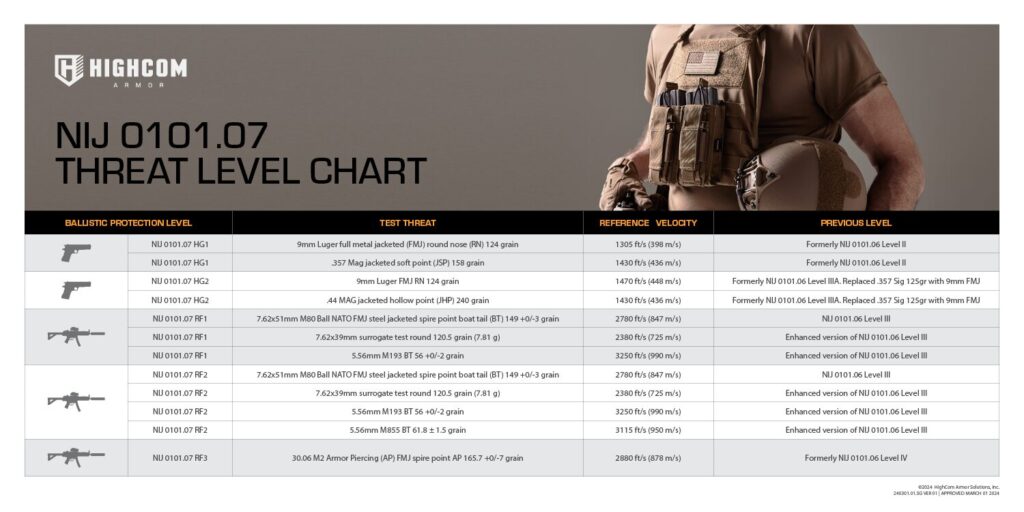
With the purchase of any Body Armor you understand that body armor is not bullet proof but bullet resistant. NIJ standards are published to help insure that a bullet will be stopped per a specified level of protection. This does not mean that it will prevent 100% of bullet penetration or that the impact will not cause other injuries even if the bullet is stopped. Body Armor is good for protection but there needs to be an understanding if a bullet strikes you there is always a risk for injury or potentially death and even if the impact is absorbed by the vest or plate defeating the bullet before it penetrates a person’s body. Some of these injures seen can happen ranging from severe bruising, broken bones, and possibly serious internal injury that could result in death. If struck by a bullet even with the vest on you should seek immediate medical attention to insure there are no internal injuries prevalent at the time of the impact.
SECTION 2 – TERMS & CONDITIONS
Certain products HighCom Armor sells require they only be sold or distributed to U.S. persons under federal laws and regulations. By completing this purchase you agree that you are a U.S. Person and currently maintain permanent residency in the United States. You further agree that these items are being purchased for personal use and that they will not be redirected or exported without first obtaining permission form the U.S. Government through the U.S. Department of State Directorate of Defense Trade Controls and/or the U.S. Department of Commerce through the Bureau of Industry & Security.
HighCom Armor may require as part of this sale the verification of your citizenship status and by doing so may require the purchasing party to provide the following document or documents in order to satisfy this requirement” Notifications requesting proof of citizenship will be sent within 24 hours by electronic form of email and/or fax requesting the following information to be provided; Please send HighCom a copy of passport, birth certificate, or the sworn affidavit of citizenship notarized form found here. If you are in Law Enforcement a photocopy of your badge or identification will also work for valid proof of status.
LAWFUL CITIZEN:
Convicted Felons and individuals with criminal records are prohibited from owning Body Armor and HighCom reserves the right to refuse any sale suspected of being ordered by or delivered to convicted felons and suspected criminals or anyone HighCom perceives as a potential threat to law enforcement or their community.
CONNECTICUT RESIDENTS:
Because of state laws, HighCom Armor will not offer for sale or deliver into the state of Connecticut any purchase with items related to body armor due to state law restricting the sale of these items. Please visit your local law enforcement supply store for support in this matter. This does not apply law enforcement officers and agencies.
PAYMENT METHODS:
HighCom Armor accepts Visa, MasterCard, American Express, Discover, PayPal, and Google Checkout through internet and telephone sales. We utilize a licensed system for credit card authorization. We use industry standard SSL (Secure Sockets Layer) encryption to protect the confidentiality of your personal information. None of this information will be shared with any third parties for any purpose. See our Privacy Policy below.
DISCOUNT PRICING:
Select distributors and government organizations qualify to receive discount pricing on certain products. Please call 1-800-987-9098 for more information.
ORDER CHANGES:
If you have any questions about your order or if you need to make a change and your order has not yet shipped, please call us at 1-800-987-9098 or by email at sales@highcomarmor.com. You can check the status of your order at any time by logging into your account on staging.highcomarmor.com.
SHIPPING:
We ship all products within 3-5 business days and larger orders, out of stock items, and custom built products may take 30-90 days depending on specifics of order. Once your order is placed online you will receive an order confirmation with the status of the order. Once the order is shipping, you will receive an email notification with a tracking number.
CANCELLATION POLICY:
Per HighCom standard terms and conditions related to our trade practices. If an order is canceled by any customer after the order has been accepted and a sales order has been provided with an estimated ship date, the customer may not cancel the order. If a customer requests a cancellation of an order after this time, the customer agrees to reimburse HighCom up to 50% of the value of the order for a cancellation fee.
This policy is related to any reason upon notification of cancellation. Under these conditions, HighCom will act accordingly to attempt the sale of these goods to alternative party(s) and if successful, HighCom will work to mitigate the cancellation fee with the customer to reduce or eliminate the fee amount.
This policy is to ensure that HighCom itself does not encounter a hardship from committing to raw materials, labor, and other resources on behalf of a customer for the purpose of intended delivery on any contract and for the purpose to recoup its cost and/or unrealized gains.
RETURN POLICY:
If you are not satisfied with your purchase, you may return it within 30 days of receipt of shipment. There are no refunds or exchanges on build-to-order or custom products. Returns will only be accepted if the item is unused, in its original condition, and its original packaging. A full refund will be applied to your credit card, if your return meets these conditions. Returns do not apply to canceled orders or decisions after shipment that the product is no longer needed due to on hand supply, change of requirement at end user point of use, or other reasons related to ordering mistakes not HighCom’s fault.
Please allow 5-10 business days from the time the item is received back at HighCom to allow us the opportunity process a refund. You are responsible for shipping cost to return the item(s), unless it was our error.
HighCom may process a return and restocking fee of up to 50% in addition to shipping charges for return items at customer fault for sizing, color, model, type, configuration, or other variant or errors made by customer during ordering.
Before returning your item(s), please go online, email, or call HighCom to obtain approval for the return along with an authorized RMA# for processing and to include on your return label.
ALL RETURNS SHOULD BE DELIVERED TO:
HIGHCOM ARMOR SOLUTIONS, INC.
RMA#________________
ATTN: RETURNS
2901 E 4TH AVE., UNIT J
COLUMBUS, OH 43219 USA
FOR YOUR PROTECTION, PLEASE USE FEDEX OR UPS FOR RETURN SHIPMENT WITH TRACKING RESULTS.
PRIVACY:
HighCom Armor takes credit card and personal data security very seriously. All personal information provided to HighCom Armor will remain private. We will not sell, lease or otherwise use information provided for any other purpose beyond the fulfillment of the order placed. The information we ask for when you order online is your name, address, phone number, credit card number and email address, and it’s used only to complete the order, to confirm the order and to confirm shipment of the order. You may opt to save your information and create an account with HighCom Armor. This information is then stored only for the purposes of faster checkout and application of discounts. HighCom Armor will give you access to the personal information you provided, by allowing you to view, update or correct your information. You will create a username and password to verify your identity before being able to access your information. “Cookies” are used by HighCom Armor only to allow you to use HighCom Armor’s web site in the most efficient manner.
ELECTRONIC COMMUNICATIONS:
When you visit HighCom Armor or send e-mails to us, you are communicating with us electronically. You agree that all notices, disclosures and other communications that we provide to you electronically satisfy any legal requirement that such communications be in writing. HighCom Armor uses your e-mail address to confirm your order and to confirm shipment of your order and to respond to any inquiries you make on-line. Any comments or feedback submitted by users of the website shall be and remain the property of HighCom. HighCom Armor is under no obligation to pay for or respond to any such comments or feedback provided by users.
CONTESTS AND GIVEAWAYS:
By participating in the HighCom Armor’s contests or giveaways, all participants must be United States citizens, at least 18 (eighteen) years of age at the time of entry, and provide valid and verifiable information upon entry. There is no purchase necessary to enter or win. The odds of winning will depend on the number of eligible entries. HighCom Armor cannot predict the odds of winning, as they have no prior knowledge of the number of entrants who will participate. A winner will be randomly selected at HighCom’s discretion. The decisions made by HighCom Armor are final and binding in all matters relating to their contests and giveaways. HighCom Armor will notify the winner(s) via a direct message or comment through the relevant social media channel specified on the contest entry page. Winner(s) must claim their prize within 5 (five) business days after the date of notification of such prize. A Contest winner’s failure to respond to the prize notification within the specified 5 (five) business days will be considered such Contest winner’s forfeiture of the prize and an alternate winner may be selected from the pool of eligible entries. If an Entrant is found to be ineligible, an alternate winner may also be selected from the pool of eligible entries. Company reserves the right to ship prizes directly to the mailing address provided by the winner(s) within a 60 day period of the winner(s) being selected. Each entry submitted in response to the Contest and in accordance with the rules will constitute an official entry. All Entrants agree to abide by these Official Contest Rules. All entries become the property of the Company. In addition, any information Entrants provide to HighCom Armor will be used to communicate with Entrants in relation to this Contest. HighCom Armor may also share this information with advertisers to contact Entrants at a future date about new products and services Company believes Entrants will find of interest. The Contest is void where prohibited or restricted by law.
COPYRIGHTS AND TRADEMARKS:
All content on this site including products, text, graphics, logos, icons, images, artwork, photographs and data compilations are the property of HighCom and protected by United States and international copyright laws. HighCom’s graphics, logos, page headers, button icons and product names are trademarks, registered trademarks or trade dress of HighCom Armor Solutions, Inc. Trademarks or trade dress may not be used in connection with any product or service that is not HighCom Armor’s, in any manner that is likely to cause confusion among customers, or in any manner that disparages or discredits HighCom Armor. You may not copy, reproduce, publish, transmit or otherwise use any copyrighted or trademarked materials present on this site without prior written consent. One or more patents apply to this Site.
LICENSE AND ACCESS TO WEBSITE:
HighCom Armor grants you a limited license to access and make personal use of this site, but not to download (other than page caching) or modify it, except with express written consent of HighCom Armor. This license does not include any resale or commercial use of this site or its contents; any collection and use of any product listings, descriptions, or prices; any derivative use of this site or its contents; any downloading or copying of account information for the benefit of another merchant; or any use of data mining, robots or similar data gathering and extraction tools. This site or any portion of this site may not be reproduced, duplicated, copied, sold, resold, visited or otherwise exploited for any commercial purpose without express written consent of HighCom Armor. You may not frame or utilize framing techniques to enclose any trademark, logo, or other proprietary information (including images, text, page layout or form) of HighCom Armor without express written consent. You may not use any meta tags or any other “hidden text” utilizing HighCom Armor’s name or trademarks without the express written consent of HighCom Armor. Any unauthorized use terminates the permission or license granted by HighCom Armor. You are granted a limited, revocable and nonexclusive right to create a hyperlink to the home page of HighCom Armor so long as the link does not portray HighCom Armor in a false, misleading, derogatory, or otherwise offensive matter. You may not use any HighCom Armor logo or other proprietary graphic or trademark as part of the link without express written permission.
RISK OF LOSS:
All items purchased from HighCom Armor are made pursuant to a shipment contract. This means that the risk of loss and title for such items pass to you upon our delivery to the carrier.
PRODUCT DESCRIPTIONS:
HighCom Armor attempts to be as accurate as possible. However, HighCom Armor does not warrant that product descriptions or other content of this site is accurate, complete, reliable, current or error-free. If a product offered by HighCom Armor itself is not as described, your sole remedy is to return it in unused condition according to our Return Policy located on this page.
PRICING:
Except where noted otherwise, the List Price displayed for products on our website represents the full retail price listed on the product itself, estimated in accordance with standard industry practice; or the estimated retail value for a comparably featured item offered elsewhere. Discounts are available to certain groups at our discretion.
DISCLAIMER OF WARRANTIES AND LIMITATION OF LIABILITIES:
This site is provided by HighCom Armor on an “as is” and “as available” basis. HighCom Armor makes no representations or warranties of any kind, express or implied, including without limitation, warranties of merchant ability or fitness for a particular purpose. As to the operation of this site or the information, content, materials or products included on this site, you expressly agree that your use of this site is at your sole risk. HighCom Armor does not warrant that this site, its servers or e-mail sent from HighCom are free of viruses or other harmful components. HighCom Armor will not be liable for any damages of any kind arising from usage of this site, including, but not limited to direct, indirect, incidental, punitive and consequential damages.
APPLICABLE LAW:
HighCom Armor Solutions, Inc. is based out of Columbus, Ohio. By visiting HighCom Armor, you agree that the laws of the state of Ohio, without regard to principles of conflict of laws, will govern these Terms and Conditions and any dispute of any sort that might arise between you and HighCom Armor Solutions, Inc.
DISPUTES:
Any dispute relating in any way to your visit to HighCom Armor or to products you purchase through HighCom Armor shall be submitted to confidential arbitration in Boston, Massachusetts, except that, to the extent you have in any manner violated or threatened to violate HighCom’s intellectual property rights, HighCom Armor may seek injunctive or other appropriate relief in any state or federal court in the state of Massachusetts, and you consent to exclusive jurisdiction and venue in such courts. Arbitration under this agreement shall be conducted under the rules then prevailing of the American Arbitration Association. The arbitrator’s award shall be binding and may be entered as a judgment in any court of competent jurisdiction. To the fullest extent permitted by applicable law, no arbitration under this Agreement shall be joined to an arbitration involving any other party subject to this Agreement, whether through class arbitration proceedings or otherwise.